Dinner prep usually reveals the problem at the worst possible moment – you turn the knob, expect heat, and one burner stays cold. If your stove burner not working issue is limited to one element, you may be dealing with a simple part failure. If several burners stop at once, the cause is often electrical, switch-related, or tied to the appliance’s power supply.
The good news is that some burner problems have straightforward explanations. The less-good news is that the right fix depends on whether you have an electric coil cooktop, a smooth-top electric range, or a gas stove. Knowing the difference helps you avoid wasting time, replacing the wrong part, or creating a safety risk.
Why a stove burner is not working
A burner can fail for a few different reasons, and the symptoms matter. If the burner does not heat at all, the issue may be a bad element, a faulty receptacle, a failed infinite switch, or a wiring problem. If it heats unevenly or only works on one setting, the control switch is often involved. If it clicks but does not light on a gas unit, ignition or gas flow is more likely.
Power issues are also more common than many homeowners expect. An electric range can appear partly functional when it has a tripped breaker or a wiring fault affecting only part of the appliance. That is why one burner problem should be looked at carefully before it becomes a larger repair.
Start with the simplest checks first
Before assuming the appliance needs a major repair, rule out the basics. Make sure the unit has power, especially if you have an electric stove and recently used several high-demand appliances at once. Check your home’s breaker panel for a tripped breaker. Some ranges can still show clock lights or partial function while a surface element circuit is compromised.
If you have an electric coil burner, remove the burner only after the stove is fully off and cool. A loose connection where the coil plugs into the receptacle can stop it from heating. In some cases, gently reseating the coil restores contact. If the burner looks blistered, cracked, or visibly damaged, the element itself may have failed.
For smooth-top electric ranges, there is less you can inspect without opening the appliance. If the glass top is intact but the burner stays cold, the issue is usually below the surface – often the radiant element, limiter, switch, or internal wiring.
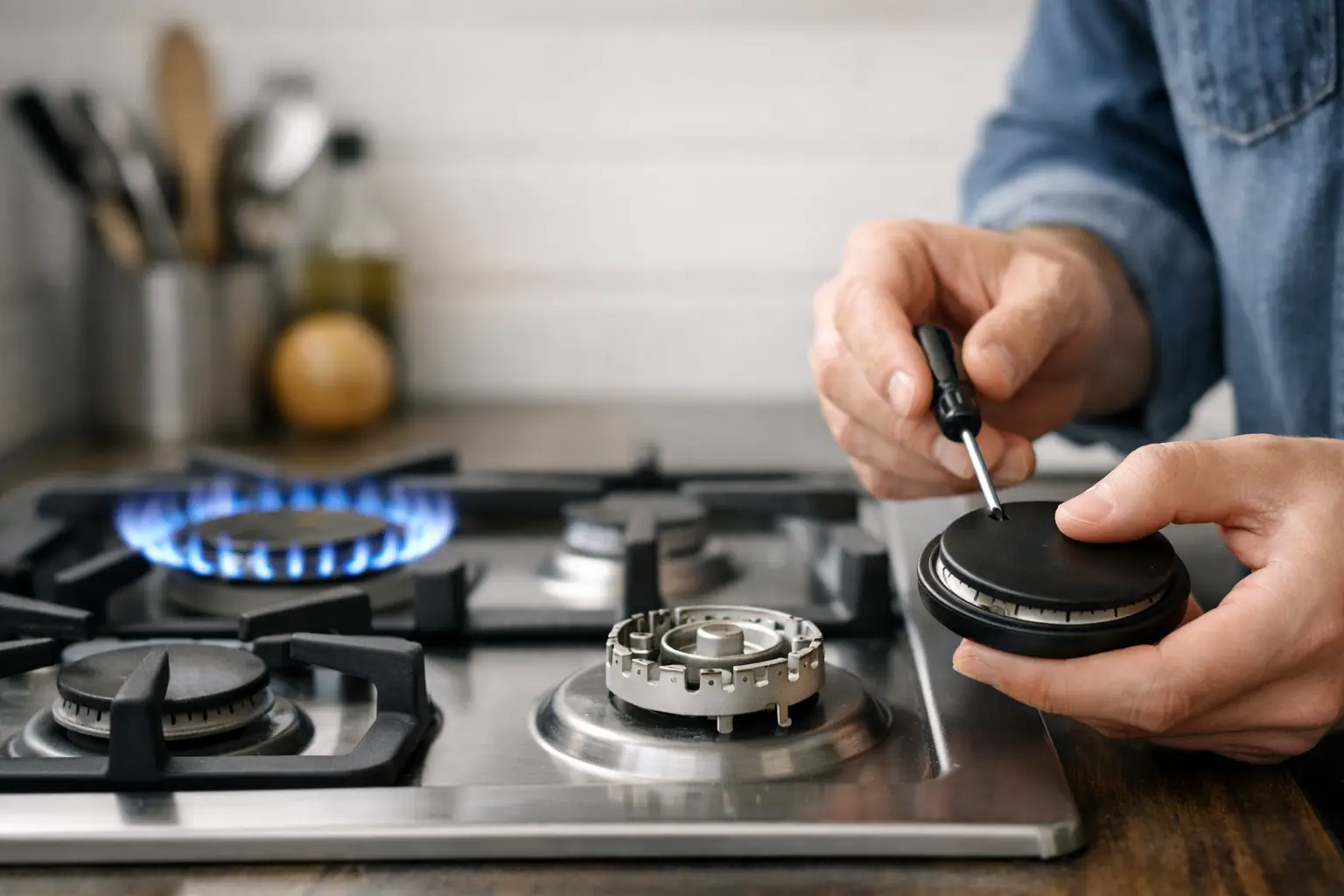
On gas stoves, listen and look closely. If you hear clicking but do not get flame, the burner cap may be out of position or the burner ports may be clogged with food debris. If there is no clicking at all, the igniter switch, spark module, or power supply may be the problem.
Electric coil burner problems
When one electric coil burner stops heating, the burner element is the most likely failure point. These elements wear out over time, especially in busy kitchens where the same burner is used every day. A damaged coil may heat weakly before failing completely, or it may stop with no warning.
The receptacle block is another common culprit. This is the socket the coil plugs into. If it is burned, melted, or discolored, the burner may not receive consistent power. In that case, replacing the coil alone will not solve the problem. The receptacle and sometimes the wiring harness must also be repaired.
The burner switch can also fail. If swapping the coil with a working burner of the same size does not move the problem, the switch or wiring becomes more likely. This is where many do-it-yourself attempts go off track, because the symptoms can overlap. A bad switch, damaged wire, or failed terminal may all look the same from the outside.
Smooth-top electric burner issues
A smooth-top range is cleaner-looking, but diagnosis is usually less obvious. If a radiant burner under the glass is not heating, the element itself may be open, the limiter may be defective, or the control switch may not be sending power correctly.
Some burners have dual-zone or expandable heating areas, which adds another layer. You may see the inner ring heat while the outer ring stays off, or the burner may only work on certain settings. That does not always mean the whole burner needs replacement. In some cases, the control for the dual-zone function is the actual problem.
Because smooth-top units require disassembly to test safely, this is often the point where professional service saves time. Guesswork can turn a targeted repair into an expensive one.
Gas stove burner not working? Check these signs
If a gas stove burner is not working, start by checking whether the burner cap is seated correctly. Even a slight misalignment can prevent ignition. Next, look for grease or food buildup in the burner holes. A clogged burner may click repeatedly without producing a steady flame.
If cleaning and repositioning the burner cap do not help, the igniter may be weak or the ignition switch may not be sending a signal. Another possibility is restricted gas flow to that burner. If multiple gas burners are affected, the issue may be broader than a single burner assembly.
Gas problems deserve extra caution. If you smell gas, do not keep testing the burner. Turn the appliance off, ventilate the area, and arrange service right away. A burner that will not ignite is inconvenient. A gas leak is urgent.
When the problem is not the burner itself
A surface burner can stop working even when the element or burner head is fine. Control switches fail, wires loosen from heat stress, and terminal connections burn over time. On some ranges, a damaged harness or internal short can affect one burner long before the rest of the stove shows signs of trouble.
There is also the question of age and overall condition. If your stove has multiple issues – a burner that fails, oven temperature problems, and controls that work inconsistently – it may not be one isolated repair. A proper diagnosis matters because replacing one visible part may leave the real issue untouched.
This is especially true in rental properties and small commercial kitchens, where heavy use accelerates wear. A burner problem in a home kitchen may build gradually. In a high-use setting, it can show up suddenly and affect daily operations immediately.
What you can safely do yourself
There are a few reasonable steps homeowners can take before booking service. You can verify power at the breaker, make sure knobs are set correctly, reseat a removable electric coil, clean burner caps and ports on a gas stove, and inspect for obvious visible damage once the unit is cool and off.
What you should not do is open the appliance and start testing live electrical components without the right tools and experience. Electric ranges use high voltage, and gas ranges combine ignition components with fuel supply. A quick online guess can lead to a wrong repair, a damaged part, or a safety issue.
If the burner repeatedly trips a breaker, sparks unexpectedly, smells hot, or shows signs of melting around the connection point, stop using it. Those are not wait-and-see symptoms.
When it makes sense to call for professional repair
If you have already checked the basics and the burner still will not work, professional diagnosis is usually the fastest path forward. That is particularly true for glass-top ranges, recurring electrical issues, gas ignition faults, and any situation where the problem may involve switches, wiring, or internal components.
A qualified technician can test whether the failure is in the burner, receptacle, switch, spark system, or wiring harness instead of replacing parts one by one. That saves time and helps avoid repeat breakdowns. For households across Greater Massachusetts, fast scheduling matters because a stove issue can disrupt every meal until it is fixed.
At Fasteny Appliance Repair, we see this problem in many forms – single burners that will not heat, gas burners that click without lighting, and cooktops with intermittent power. The right repair starts with an accurate diagnosis, a clear quote, and service that gets your kitchen working again without hidden surprises.
Repair or replace?
If the stove is relatively new and the issue is limited to one burner, repair is usually the practical choice. Burner elements, switches, receptacles, and igniters are common service items. On an older range with repeated failures, the decision depends on part cost, appliance condition, and how reliable the unit has been overall.
There is no one-size-fits-all answer. A simple burner repair can be very worthwhile. A larger electrical problem on an aging stove may point in a different direction. What matters is getting an honest assessment before spending money.
A stove problem rarely fixes itself, and one nonworking burner has a way of becoming a bigger disruption when the kitchen is busy. If something feels off, trust that instinct, use the appliance carefully, and get the issue checked before your next rushed weeknight dinner depends on it.