You notice it when the milk is warmer than it should be, the produce drawer feels damp, or the freezer still works but the fridge section does not. If you are wondering why is my refrigerator not cooling, the goal is usually simple: save the food, figure out whether the fix is minor, and avoid wasting time on guesswork. Fasteny Appliance Repair troubleshoots this problem for homeowners across Billerica, Reading, and nearby Massachusetts towns, and many cases start with a handful of checks you can do yourself. If your fridge is warm but the freezer stays cold, that specific pattern has its own fixes.
A refrigerator that is not cooling properly can fail for a few very different reasons. Some are basic, like blocked vents or dirty condenser coils. Others point to a part failure, such as a bad evaporator fan, a defrost problem, or a thermostat issue. The key is to check the simple causes first, then pay attention to the symptoms that suggest professional repair is the smarter next step.
How to troubleshoot fridge cooling without making it worse
Start with the conditions that affect cooling before assuming a major breakdown. Many refrigerator service calls begin with something external to the sealed system. That is good news, because these are the fastest things to rule out.
Check the temperature settings first. It sounds obvious, but settings are often bumped during cleaning, grocery loading, or by children reaching for snacks. The fridge should usually be set around 37 to 40 degrees Fahrenheit, and the freezer at 0 degrees. If the control is too warm, give the appliance several hours to stabilize after adjusting it.
Next, look at how full the refrigerator is and how air moves inside it. A packed fridge can block vents and prevent cold air from circulating. On the other hand, an almost empty refrigerator can also struggle to hold a stable temperature depending on the model and room conditions. If containers or food packages are pressed against the rear vents, move them and see whether airflow improves.
Then check the door seals. A loose or cracked gasket lets warm air leak in and forces the refrigerator to run longer while cooling less effectively. Close a sheet of paper in the door and gently pull. If it slides out too easily in several spots, the seal may not be tight enough. Also look for spills, grease, or crumbs that keep the gasket from closing flush.
Common reasons a fridge is not cooling properly
When the basics look fine, the next step is matching the symptom to the likely cause. Refrigerators cool through airflow, heat transfer, and precise cycling of several parts. When one piece of that process fails, the temperature changes in ways that can tell you a lot.
Dirty condenser coils
Condenser coils release heat from the refrigerator. When they are coated with dust, pet hair, or grease, the appliance has to work harder to cool. In some homes, especially with pets, this buildup happens faster than people expect.
If your fridge feels warm on the outside, runs constantly, or seems to cool weakly, dirty coils are a strong possibility. Unplug the unit first, then locate the coils either behind the fridge or underneath it. If they are visibly dirty, cleaning them carefully with a coil brush and vacuum can improve performance. Just be gentle – bending the coils or damaging nearby wiring creates a bigger problem.
Blocked air vents
In many refrigerator designs, cold air is produced in the freezer and pushed into the fresh food section. If that air path is blocked, the freezer may seem fine while the refrigerator gets warm.
Look for frost-covered packages, oversized containers, or bins pushed too far back. This is one of the most overlooked answers to how to troubleshoot fridge cooling, because the appliance is technically still running, just not circulating air where it needs to.
Evaporator fan problems
If the freezer is cold but the fridge compartment is warm, the evaporator fan may not be moving cold air into the refrigerator section. You might notice weak airflow from interior vents or hear unusual squealing, clicking, or silence where a fan would normally run.
This issue usually goes beyond basic DIY troubleshooting. A failed fan motor, ice buildup around the fan, or a wiring issue can all produce similar symptoms. The difference matters, because replacing a fan when the real problem is in the defrost system will not solve the cooling failure.
Frost buildup from a defrost issue
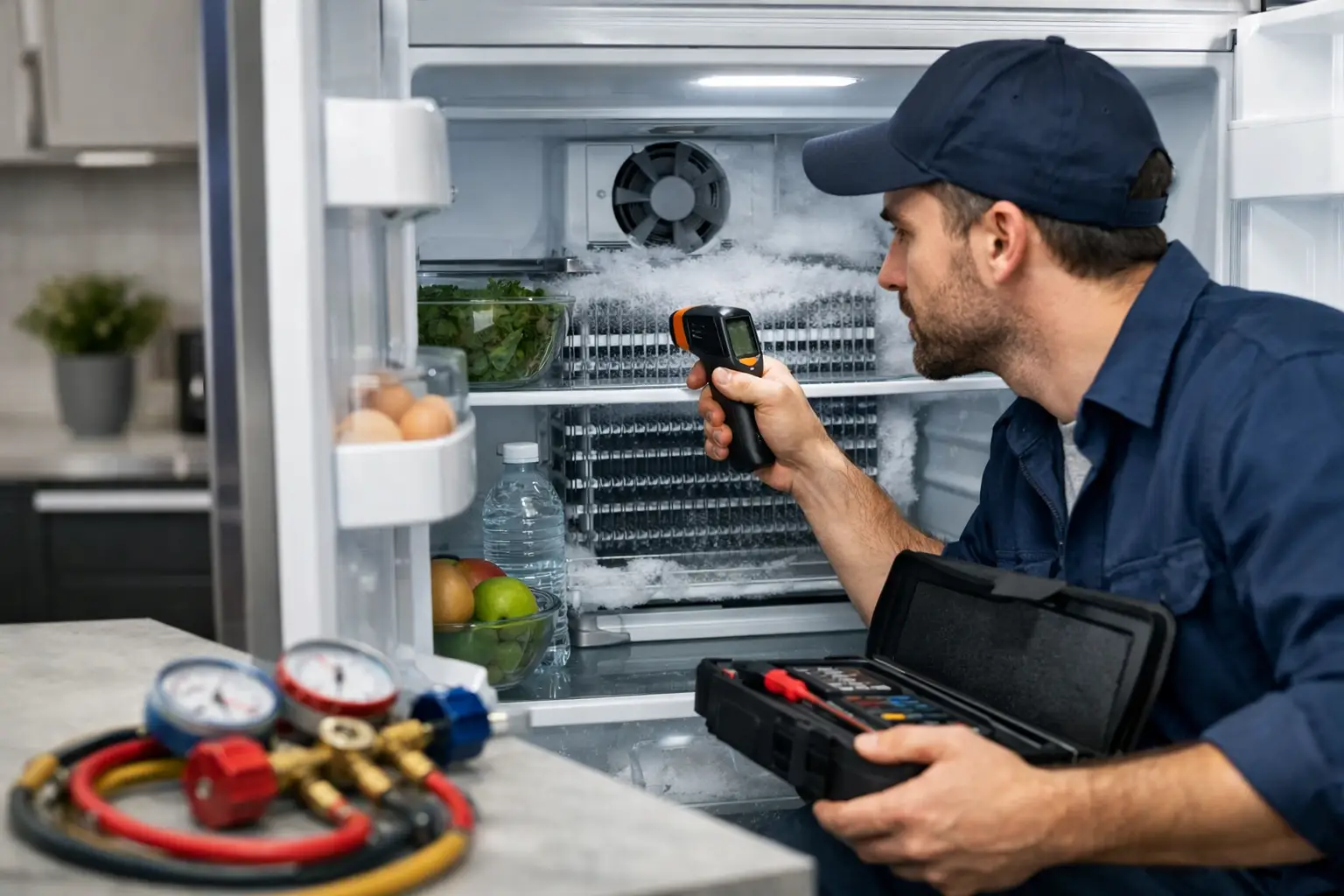
Heavy frost on the back interior freezer panel is a strong warning sign. That often means the defrost system is not clearing ice from the evaporator coils. When the coils freeze over, air cannot move properly, and cooling drops off in the refrigerator section first.
Some people unplug the appliance to melt the ice and restore cooling temporarily. That can work for a short time, but it does not fix the failed heater, thermostat, sensor, or control issue causing the frost to return. If you see this pattern, repair is usually the practical answer.
Thermostat or temperature sensor failure
A refrigerator that cools too much, not enough, or cycles unpredictably may have a control problem rather than an airflow issue. Depending on the model, the fault could involve the temperature control thermostat, thermistor, or electronic control board.
This is where symptoms overlap. A unit may seem to cool occasionally, then warm up again, which can make it look like the problem resolved on its own. In reality, intermittent temperature control problems often get worse and can lead to food spoilage if left alone.
Brand-specific reasons a refrigerator is not cooling
The core causes are similar across brands, but the details and reset steps differ. A Samsung refrigerator not cooling is often stuck in Cooling Off or demo mode, or has a frosted evaporator behind the back panel. LG and Frigidaire refrigerators not cooling frequently trace back to a failed evaporator fan or a sealed-system fault, while Whirlpool and GE models commonly struggle with dirty condenser coils, a stuck damper, or a defrost failure. Checking your model’s control panel for a demo or “OF” mode is a smart first step, since that alone stops many units from cooling.
Samsung’s own guidance on refrigerator cooling issues walks through several of these checks, and the same logic applies to most major brands. If a brand-specific reset does not restore cooling, the cause is usually mechanical and worth a professional look.
What to check before calling for service
If you want to narrow down the issue before scheduling repair, focus on what you can safely observe. Listen to the appliance. Is the compressor humming? Do you hear a fan running when the door switch is pressed? Is there clicking every few minutes without steady operation? Those details help point to whether the problem involves airflow, controls, or startup components.
Look for visible frost, water under crisper drawers, or condensation on shelves. Check whether the freezer is also warm or only the fresh food section. If both compartments are warming up, the issue may be more serious than a vent blockage. If only the refrigerator section is warm, airflow and defrost faults become more likely.
Also think about timing. Did the cooling problem begin after a power outage, moving the appliance, overloading it with groceries, or cleaning behind it? Context matters. A fridge that stopped cooling after being pushed tightly against the wall may be overheating from poor ventilation. A fridge that failed after a storm may have an electrical or control issue.
When DIY fridge troubleshooting stops making sense
There is a point where more trial and error costs more than a service call. If the refrigerator is running but not cooling after you have checked settings, airflow, seals, and coils, deeper diagnosis is usually needed. The same is true if you notice a burning smell, repeated clicking, heavy frost buildup, water leaking from inside the cabinet, or spoiled food despite apparently normal operation.
At that stage, professional refrigerator repair is the practical move. It helps to know the likely refrigerator repair cost in advance, and our guide to common refrigerator problems explains how these parts fit together.
Sealed system problems, compressor issues, control board faults, and refrigerant-related failures are not practical DIY repairs for most homeowners or small business operators. They require correct testing, the right tools, and accurate part diagnosis. Guessing can lead to buying unnecessary parts or delaying the actual fix while the problem gets worse.
For families, landlords, and local businesses, downtime matters. A refrigerator that kind of cools is often more frustrating than one that quits completely because it creates false confidence while temperatures remain unsafe. Fast, accurate diagnosis is what protects the food and prevents repeat repair costs.
How to troubleshoot fridge cooling and know when to call a pro
A good rule is this: if the fix involves cleaning, clearing space, or resetting controls, it is reasonable to try yourself. If the symptoms involve fans not running, frost patterns, inconsistent temperatures, electrical behavior, or a compressor that will not stay on, professional service is the better move.
That is especially true for built-in units, French door models, and commercial or high-use refrigerators. These systems can be more sensitive to airflow, sensor calibration, and control board failures. What looks like a simple cooling issue may have more than one cause.
At Fasteny Appliance Repair, this is exactly the kind of issue our technicians diagnose every day for homeowners and businesses across Greater Massachusetts. The value is not just replacing a part. It is finding the actual reason the fridge stopped cooling, explaining the repair clearly, and getting the appliance back to dependable operation without hidden fees or wasted time.
If your refrigerator is losing temperature, act early. A warm fridge rarely fixes itself, and small cooling issues have a way of becoming urgent right when the appliance is full. The sooner you narrow down the cause, the better your chances of protecting both your food and your schedule.
Frequently Asked Questions
Why is my refrigerator not cooling?
The most common causes are dirty condenser coils, blocked interior air vents, a failed evaporator fan, a defrost system problem, or a faulty thermostat or temperature sensor. Many units are also simply set too warm or stuck in a demo/cooling-off mode, so check the settings and airflow before assuming a part has failed.
What should I check first when my refrigerator is not cooling?
Confirm the unit has power, the temperature is set correctly, and the doors seal fully. Then make sure vents inside are not blocked by food, give the condenser coils a cleaning, and check the control panel for a demo or “OF” mode. These simple checks resolve a large share of cooling complaints.
My refrigerator is not cooling but the freezer still works. What does that mean?
That specific pattern usually points to an airflow or defrost problem between the freezer and fridge compartments rather than a total failure. Because the fixes are a little different, we cover them in our guide on why a fridge is warm while the freezer stays cold.
How long is food safe if my refrigerator stops cooling?
Perishable food stays safe only about four hours once the refrigerator rises above 40°F, so act quickly. Keep the door closed to hold temperature, move critical items to a cooler with ice if needed, and start troubleshooting or call for service right away.
When should I call a professional for a refrigerator that is not cooling?
If cooling does not return after you check settings, airflow, seals, and coils, or if you notice a burning smell, heavy frost, water leaking inside, or spoiled food, it is time for a technician. Homeowners in Billerica, Reading, and across Massachusetts can have Fasteny Appliance Repair diagnose sealed-system and compressor faults safely.
Conclusion
A refrigerator not cooling is stressful, but it is often fixable once you work through the usual suspects: settings, airflow, door seals, condenser coils, and any brand-specific demo mode. If those checks do not restore cold temperatures, the problem is likely a fan, defrost, or sealed-system fault that needs professional tools and testing.
Do not let a warm fridge sit and spoil a full load of food. Whether you are in Billerica, Reading, Peabody, or Waltham, Fasteny Appliance Repair can diagnose and fix the cause fast across Massachusetts. Request service online or call (617) 618-3311 to get your refrigerator cooling again.