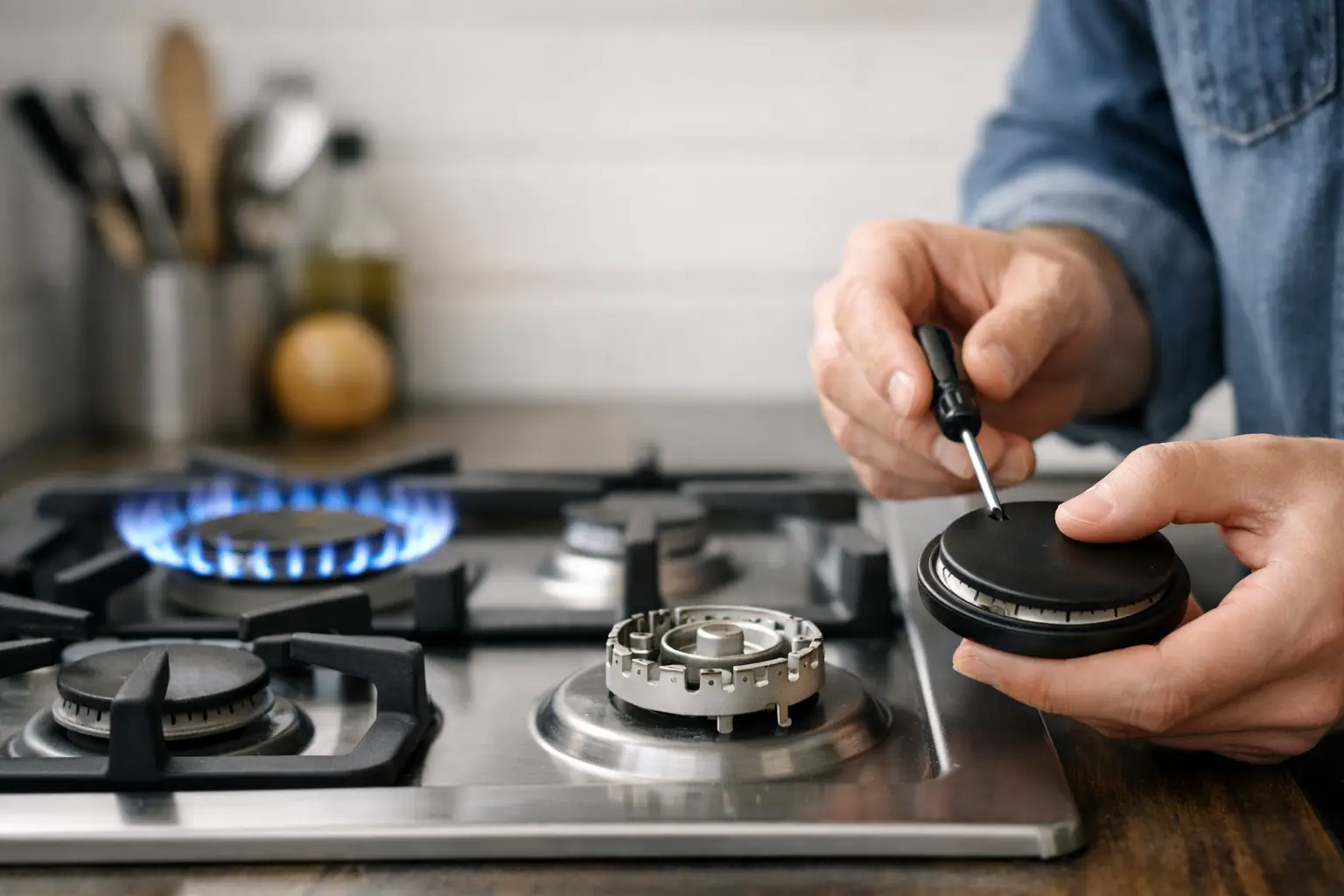
You turn the knob, wait for the click or the glow, and nothing happens — one burner stays stone cold while the rest of the stove works fine. A stove burner not working is one of the most common cooktop complaints, and the fix is often a single inexpensive part. At Fasteny Appliance Repair, we repair electric, glass-top, and gas stove burners for homeowners in Reading, Waltham, and towns across Massachusetts, frequently the same day.
This guide covers why a burner stops working on each type of stove, brand-specific quirks, and the checks you can safely make before calling a technician.
At Fasteny Appliance Repair, we fix a stove burner not working on electric, glass-top, and gas ranges for homeowners across Reading, Peabody, and Waltham.
Why Is My Stove Burner Not Working?
The cause depends on the type of stove. On an electric coil stove, a single dead burner usually means a burnt-out coil, a corroded burner socket, or a failed switch. On a glass or smooth-top stove, the radiant element under the glass or its control switch is the usual suspect. On a gas stove, a burner that will not light points to clogged ports, a wet or misaligned burner cap, or a weak igniter. When several burners fail at once, the problem is more likely the control board or power supply than the burners themselves.
Start With the Simplest Checks First
Before replacing anything, rule out the easy causes. Make sure the burner is fully seated in its socket on a coil stove, that the burner cap sits flat and dry on a gas stove, and that the cooktop is clean around the burner. Confirm the stove has power and, for an electric range, check the 240-volt double breaker, since one tripped leg can kill some burners while others still work. For a gas range, confirm the gas supply is on and other burners light.
Electric Coil Burner Not Working
Burnt-out coil element
Coil elements fail with age and often show a blister, break, or scorched spot. The quickest test is to swap the dead coil with a working one of the same size; if the problem moves with the coil, the element is bad and needs replacing.
Damaged burner socket
The socket the coil plugs into can char or corrode, breaking the connection. If a known-good coil still will not heat in that spot, the socket or its wiring is the likely fault.
Faulty infinite switch
The infinite switch controls the burner’s heat level. When it fails, the burner may stay cold, stay stuck on high, or cycle oddly. This is a technician-level repair.
Glass-Top (Smooth-Top) Electric Burner Not Working
Failed radiant element
On a glass-top stove the heating element sits under the glass. When it burns out, that zone stays cold while the others heat normally. A healthy element glows evenly; one that never glows likely needs replacing.
Control switch or board
Dual-ring burners rely on a switch that selects the element size, and the control board routes power to each zone. A faulty switch or board can leave one burner dead even when the element itself is fine.
Wrong or warped cookware
Smooth-tops need flat, compatible pans to make good contact, and induction models need magnetic cookware. A burner that seems weak may simply be losing heat to a warped pan. If you use a separate cooktop, our guide on a cooktop not working covers those units in more detail.
Gas Stove Burner Not Working
Clogged ports or a wet burner cap
Food and grease easily block the small ports around a gas burner, and a cap knocked out of place or left wet after cleaning will keep it from lighting. Clean the ports with a pin or brush, dry the cap fully, and reseat it before assuming a part has failed.
Weak igniter or spark module
If a single burner clicks but will not light after cleaning, its igniter is likely weak. If every burner clicks continuously, the spark module or ignition switch is usually to blame. These repairs involve the gas system and are best left to a professional.
A safety note: gas cooking equipment should be treated with care, and unattended cooking is the leading cause of home fires. Keep the area around the burners clear and review the USFA’s cooking fire safety guidance. If you smell gas, do not use the stove — leave and call your gas utility.
Brand-Specific Stove Burner Problems
GE and Kenmore
On GE and Kenmore ranges, a dead electric burner most often traces to the coil, the burner socket, or the infinite switch, and a simple swap-test usually pinpoints it.
Samsung and LG
Samsung and LG glass-top and gas ranges may fail at a single radiant element or igniter, and their control boards are a known point of failure on some models.
Frigidaire and Whirlpool
Frigidaire and Whirlpool burners commonly come back to the element, socket, or gas igniter — the same core parts found across most brands.
When the Problem Is Not the Burner Itself
If several burners stop working at the same time, suspect the shared parts rather than each burner: a tripped leg of the 240-volt breaker, a failing control board, or damaged wiring behind the cooktop. These faults need a professional to test safely.
What You Can Safely Do Yourself
Stick to no-risk steps: reseat and swap-test electric coils, clean and dry gas burner caps and ports, reset the breaker, and confirm your cookware is flat and compatible. Avoid opening the gas line, prying under the glass top, or testing live electrical parts unless you are trained. Anything beyond these basics is a job for a technician.
When to Call for Professional Repair
If a burner still will not work after the simple checks, if you smell gas, or if more than one burner is out, it is time for a pro. We repair coils, sockets, switches, radiant elements, igniters, and control boards across Massachusetts. See our stove repair service for coverage, or read our broader guide on a stove not working if other functions are affected too.
Repair or Replace?
A single burner repair — a coil, socket, igniter, or switch — is usually inexpensive and well worth it. Replacement makes more sense when several systems are failing, the control board has gone on an older range, or the stove is well past a decade of service.
Frequently Asked Questions
Why is my stove burner not working?
On an electric coil stove it is usually a burnt-out coil, a corroded burner socket, or a failed infinite switch. On a glass-top stove it is often the radiant element or its control switch, and on a gas stove it is typically clogged ports, a wet burner cap, or a weak igniter.
Why is only one burner not working when the others are fine?
A single dead burner points to that burner’s own parts — its coil and socket on an electric range, or its igniter and ports on a gas range — rather than the whole stove. Swapping an electric coil with a matching working one quickly shows whether the coil or the socket is at fault.
My gas burner clicks but will not light. What is wrong?
Clicking means the igniter is sparking but the gas is not catching. Clean the burner ports, dry the cap after any spills, and reseat it. If one burner still will not light, its igniter is likely weak; if every burner clicks nonstop, the spark module usually needs service.
My electric burner will not heat but the indicator light is on. Why?
Power is reaching the control but not the element. The most common causes are a burnt-out coil or radiant element, a damaged burner socket, or a failed infinite switch. A swap-test with a known-good coil helps narrow it down.
Should I repair or replace a stove with a dead burner?
A single burner is usually cheap to repair and worth fixing. Replacement makes more sense if several burners or the control board have failed, or if the range is old and would need multiple repairs.
Conclusion
A stove burner not working almost always comes down to one part — a coil, socket, switch, radiant element, or igniter — and most are quick, affordable fixes. Handle the safe checks yourself, and leave gas and electrical work to a professional. If a burner has stopped working in Peabody, Brookline, or anywhere across Massachusetts, Fasteny Appliance Repair can help. Book online through our request form, visit our homepage, or call +1 (617) 618-3311 to schedule same-day service.