
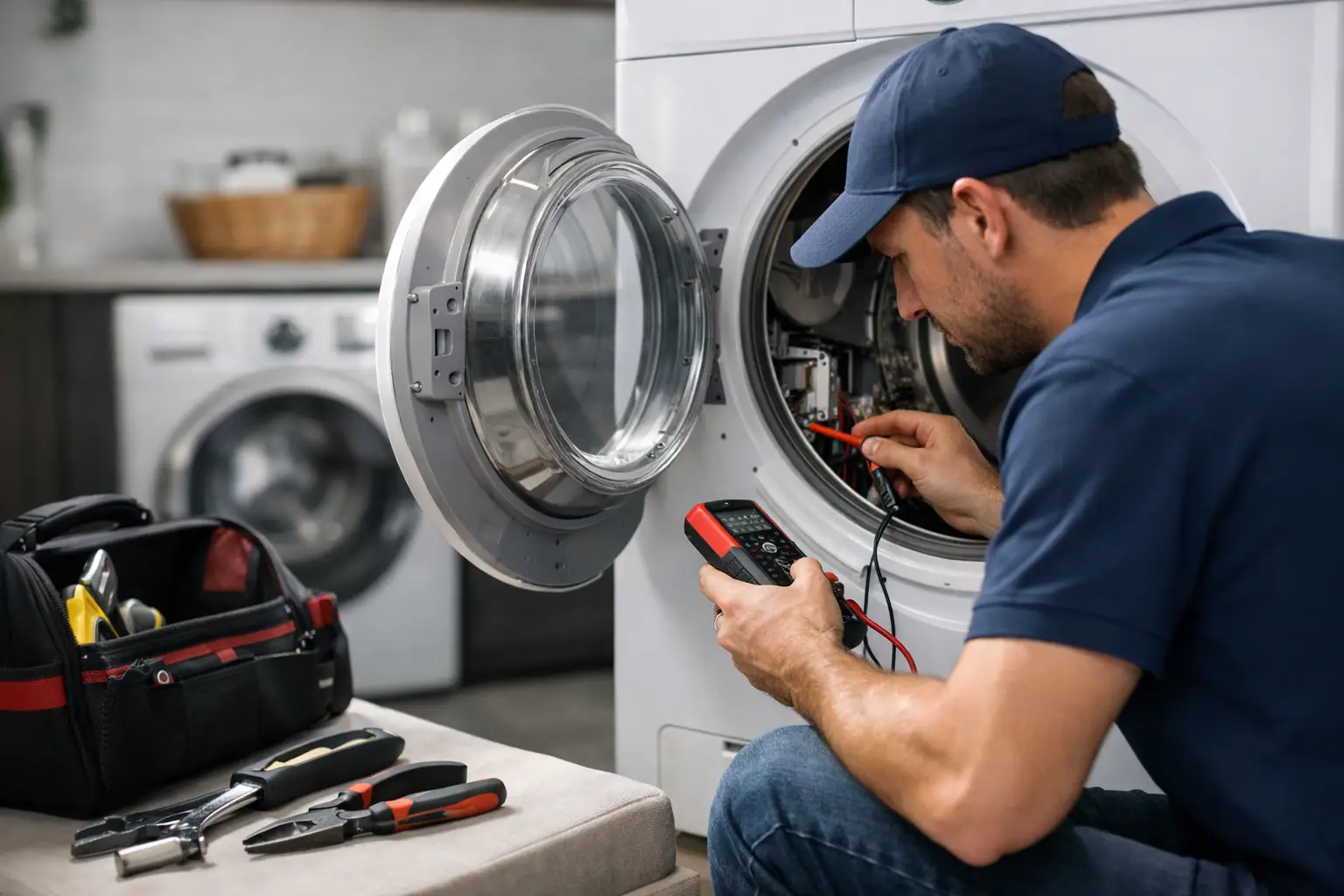
A dryer that stops heating or takes three cycles to dry a load can disrupt an entire week. This Waltham dryer repair guide helps you separate the simple checks you can make safely from problems that need a trained appliance technician, so you can get laundry moving again without guessing or risking a larger repair.
Start With Safety and the Simple Checks
Before checking anything inside the dryer, unplug an electric model. For a gas dryer, turn off the gas supply valve if you smell gas, hear hissing, or suspect a gas-related problem. Do not run a gas dryer with a damaged or disconnected vent. Routine dryer maintenance, like cleaning the lint filter and vent, prevents many of the problems below.
Start with the issues that can look like a major failure but are often external to the appliance. Make sure the dryer is firmly plugged in, the door closes completely, and the control panel is set to a heated cycle rather than air fluff or no heat. If the dryer has a delay-start setting, confirm it has not been selected.
For an electric dryer, check the circuit breaker panel. Most electric dryers use a double breaker. One side can trip while the other remains on, allowing the drum to turn without producing heat. Reset a tripped breaker once. If it trips again, stop using the dryer and schedule service. Repeated breaker trips can point to an electrical fault in the dryer, wiring, or outlet.
A clean lint screen is also essential, but it is not the only airflow check that matters. Remove lint from the screen before every load, then look at the outdoor vent hood while the dryer runs. The flap should open and release a strong flow of warm, moist air on a heated cycle. Weak airflow can cause long dry times, overheating, damp loads, and automatic shutdowns.
Waltham Dryer Repair Guide: Match the Symptom
The symptom tells you where to start, but it does not always reveal the exact failed part. Modern dryers use several safety switches, sensors, heating components, and control functions that can produce similar results. These common scenarios can help you decide what is reasonable to check and when professional diagnosis is the better choice.
The dryer will not start
If the display lights up but the dryer will not begin a cycle, check that the door is fully latched. A door switch that does not register as closed will prevent operation. Also verify that the control lock is off and that the selected cycle has been started according to the manufacturer’s instructions.
If there is no response at all, the cause may be the outlet, power cord, terminal block, thermal fuse, start switch, belt switch, or electronic control. These parts require electrical testing and, in some cases, access to high-voltage connections. A technician can identify the failed component rather than replacing parts based on a guess.
The drum turns, but there is no heat
This is one of the most common dryer calls. First, confirm the dryer is on a heat-producing cycle and check the breaker if it is an electric model. If the breaker is normal and the appliance still runs cold, likely causes include a failed heating element, igniter, gas valve coils, thermostat, thermal fuse, or control board.
Gas dryers add an important safety consideration. If the dryer tumbles but does not heat, do not attempt to disassemble the burner assembly unless you are qualified to work with gas appliances. A technician should inspect ignition, flame operation, gas valve components, and airflow as one system.
Clothes take too long to dry
Long drying times are often caused by restricted venting, not a broken dryer. Clean the lint screen, then inspect the flexible duct behind the appliance for crushing or sharp bends. The vent route should be as short and direct as practical, with the correct type of duct material. Plastic or foil-style accordion ducts can trap lint and are more likely to kink.
If the vent hood outside barely opens, the restriction may be farther down the line. This is especially common in condos, multifamily properties, and homes with long vent runs. Do not keep running the dryer repeatedly to compensate. Poor airflow forces the appliance to work harder and can create an overheating and fire risk.
When airflow is clear but clothes are still damp, the issue may be a weak heating system or a moisture sensor that is not reading properly. Wiping the sensor bars inside the drum with a soft cloth can remove residue from dryer sheets or fabric softener. If sensor cycles still end early, professional testing is the next step.
The dryer is unusually noisy
A few loose coins can make a surprising amount of noise, so check pockets and the drum before assuming a mechanical failure. A thumping sound may come from an item caught in the drum seal or a dryer that has been sitting unused long enough for rollers to develop flat spots.
Persistent squealing, scraping, grinding, or rhythmic banging usually points to worn drum rollers, a damaged idler pulley, a belt issue, blower wheel damage, or an object lodged where it should not be. Continuing to run the dryer can turn a manageable wear-part repair into damage to the drum, motor, or housing.
The dryer stops mid-cycle or gets too hot
A dryer that shuts off before the load is done may be overheating because it cannot exhaust air properly. Clean the lint filter and check the vent outlet before using it again. A blocked vent can cause high-limit safety components to activate.
Other causes include a failing motor, thermal fuse, thermostat, moisture sensor, or control board. If the dryer cabinet feels unusually hot, you smell burning, or you notice a hot electrical odor, unplug the appliance and arrange service promptly. Do not treat repeated shutdowns as a minor inconvenience.
When a DIY Fix Makes Sense
Homeowners can safely handle routine maintenance and basic external checks. That includes cleaning the lint screen, verifying the correct cycle setting, checking for a tripped breaker, making sure the door closes, and looking for obvious vent crushing behind the dryer.
It is reasonable to replace a lint screen or straighten a non-damaged, accessible vent connection. However, opening the cabinet, testing live electrical components, replacing heating parts, or working around a gas burner is different. Dryers can retain sharp edges, use high-voltage power, and rely on safety devices that should be installed correctly.
The trade-off is straightforward: a small amount of troubleshooting may save a service call when the issue is a setting or blocked exterior vent. But do-it-yourself parts replacement can become expensive when the original diagnosis is wrong. It can also mask the actual cause, such as poor airflow that damaged a thermal fuse in the first place.
What a Professional Dryer Diagnosis Should Include
A proper dryer repair visit should do more than replace the part associated with the first symptom. The technician should verify power supply or gas operation, inspect heating and safety components, evaluate airflow, and test the appliance through a cycle when possible.
For example, a blown thermal fuse may explain why a dryer will not run, but the technician should also determine why it blew. If a blocked vent caused overheating, replacing only the fuse may lead to the same failure again. This is why clear diagnosis matters as much as the repair itself.
For landlords and small business operators, fast restoration also matters. A shared laundry area or rental unit with an out-of-service dryer can create immediate tenant frustration. Asking for an upfront explanation of the issue, recommended repair, parts availability, and expected cost helps avoid surprises and makes it easier to decide whether repair is worthwhile.
Repair or Replace: Make the Practical Call
Most dryers are worth repairing when the cabinet and drum are in good condition and the problem involves a common service part such as a belt, roller, thermostat, heating element, igniter, or switch. Age matters, but it is not the only factor. A well-maintained dryer can often provide years of additional use after a targeted repair.
Replacement may make more sense when the appliance has multiple major failures, substantial rust or drum damage, recurring control board issues, or a repair estimate that approaches the cost of a comparable replacement. A technician can explain the condition of the appliance honestly, including whether a repair is likely to be durable or simply a short-term solution.
If your dryer is not heating, is shutting down, or is making a new mechanical noise, acting early usually protects both the appliance and your schedule. Fasteny Appliance Repair provides responsive dryer diagnosis for Waltham and Greater Massachusetts customers, with clear quotes and service focused on getting the repair done right the first time. Need help with another appliance? See our Waltham washer repair service, or learn more about dryer repair across Massachusetts.
Frequently Asked Questions
How quickly can I get dryer repair in Waltham?
In many cases we offer same-day or next-day dryer service for Waltham and Greater Boston. Reaching out early in the day and describing the symptom improves the chance of a same-day window. You can request service online anytime.
What are the most common dryer problems you repair?
No heat, long drying times, failure to start, loud or grinding noises, and dryers that stop mid-cycle. Most trace to a heating element, thermal fuse, belt, roller, or thermostat.
Is it worth repairing my dryer or replacing it?
If the cabinet and drum are sound and the fault is a common part like a belt, roller, or heating element, repair is usually the practical choice. Repeated failures on an older unit lean toward replacement.
Do you repair both gas and electric dryers?
Yes. Gas and electric dryers share many symptoms but need different repairs, so it helps to know which type you have when you schedule.
How much does dryer repair cost in Waltham?
It depends on the part and dryer type. A technician confirms the cause and gives a clear quote before starting, so there are no surprises.